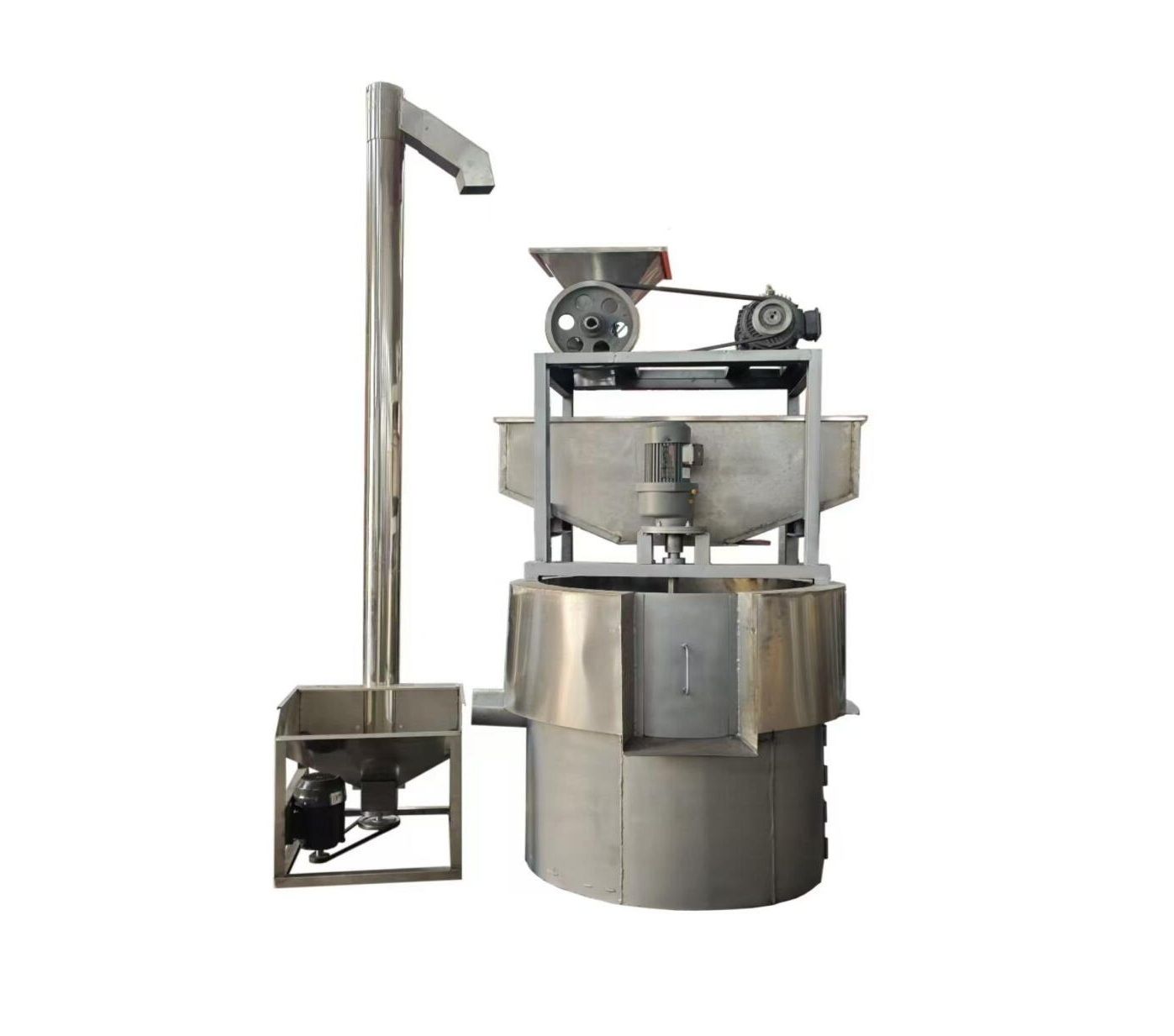
Integrated Feed-Crush-Roast All-in-One Unit
An integrated unit combining automatic feeding, crushing, and roasting in one machine group. Designed for streamlined production with reduced manual handling between process steps. Suitable for tea seed and other oil seed processing lines.
- Three processes combined into one compact unit
- Automatic feeder — reduces manual labor significantly
- Integrated crusher — immediate crushing after feeding
- Thermal oil roaster — continuous heating and stirring
- Reduces manual handling between each process step
- Output: 500-1000 kg/h depending on configuration
- Ideal for tea seed processing lines
- Customizable configuration based on your requirements
Why Go Integrated?
Traditional Setup (Separate Machines)
- Manual loading into crusher
- Crushed material moved to roaster manually
- Roasted material moved to steamer
- Each step requires separate operator attention
- More floor space needed
- Labor-intensive operation
All-in-One Unit
- Auto-feeder loads directly into crusher
- Crushed material flows directly into roaster
- Continuous operation with minimal intervention
- One operator can manage entire unit
- Compact footprint
- Lower labor costs over time
How the Integrated Feed-Crush-Roast Machine Works
The automatic feed crush roast machine combines three traditionally separate processing steps into one continuous, automated workflow. Raw oil seeds are loaded into the automatic feeder hopper, which meters material at a controlled rate into the integrated crusher. The crusher — typically a hammer-mill or roller-type mechanism — breaks seed hulls and reduces particle size to improve heat transfer and oil release in downstream pressing. The crushed material then flows directly into the thermal oil roaster, where a heated jacket (using food-grade thermal oil as the heat transfer medium) roasts the crushed seeds at uniform, controllable temperatures while a mechanical stirrer prevents scorching.
This integrated oil mill design eliminates three manual transfer points — from feeder to crusher, from crusher to roaster, and from roaster to the next station. In a traditional separate-machine setup, workers must shovel or convey material between each machine, risking spillage, inconsistent timing, and heat loss. The all-in-one unit keeps material continuously moving through the processing stages at steady temperature and throughput. For tea seed oil processing — where consistent roasting temperature is critical to produce the signature aroma — this integrated approach delivers batch-to-batch uniformity that separate machines struggle to match. Output ranges from 500 to 1000 kg/h depending on the crusher and roaster configuration selected, and the entire unit can be managed by a single operator, reducing labor costs by 50-60% compared to separate-machine setups.
Application Scenarios & Use Cases
Camellia (Tea Seed) Processing Lines (Southern China, Vietnam)
Tea seeds demand precise roasting to develop their characteristic nutty aroma without scorching. The thermal oil roaster in this automatic oil processing unit maintains ±2°C temperature control, ideal for camellia seed lines producing 500-1000 kg/h.
Groundnut Oil Mills (West Africa, India)
Groundnuts require thorough crushing and even roasting before pressing to maximize oil release. Nigerian and Senegalese groundnut oil millers use this integrated oil mill to replace three separate machines, saving floor space and reducing staff from 3-4 workers to just one operator.
Sesame Processing (Ethiopia, Sudan, Myanmar)
Sesame seeds are small and require controlled roasting to avoid burning. The integrated crusher-roaster combination processes sesame at a steady rate with uniform heat distribution — critical for producing the golden color and aroma premium sesame oil buyers expect.
Flexible Multi-Seed Operations (Southeast Asia)
For mills processing multiple seed types — coconut, palm kernel, peanut, soybean — the configurable automatic feed crush roast machine can switch between seed types with minimal downtime. Adjust crusher gap, roaster temperature, and feed rate to match each seed's characteristics.
Operation Tips & Best Practices
- Seed moisture check: Ensure seeds are at 5-7% moisture before feeding into the automatic oil processing unit. Overly moist seeds gum up the crusher; overly dry seeds create excessive dust.
- Gradual temperature ramp-up: Allow the thermal oil roaster 15-20 minutes to reach target temperature. Do not feed seeds into a cold roaster — they will absorb heat unevenly and produce inconsistent results.
- Feed rate calibration: Start at 50% of rated feed capacity and increase gradually while monitoring crusher motor current and roaster temperature stability. The optimal rate varies by seed type and desired roast level.
- Regular crusher inspection: Check hammer/blade wear weekly. Worn crushing elements reduce throughput and produce uneven particle sizes, which in turn affects roasting uniformity.
- Thermal oil level check: Inspect the thermal oil expansion tank level monthly. Low oil causes hot spots and temperature fluctuations. Top up with the same food-grade thermal oil type only.
- Stirrer speed adjustment: For delicate seeds (sesame, flax), reduce stirrer speed to prevent seed breakage. For robust seeds (peanut, soybean), higher speed ensures even roasting.
- End-of-day cleaning: Run the roaster empty at reduced temperature for 5 minutes to burn off residual material, then wipe accessible surfaces. This prevents carbonized buildup that taints the next day's production.
Frequently Asked Questions
What is the hourly output?
500-1000 kg/h depending on configuration, seed type, and desired roast level. Tell us your material and target capacity for a tailored configuration.
Which seeds does it process?
Primarily tea seeds (camellia), plus groundnut, sesame, soybean, rapeseed, sunflower, coconut, and palm kernel. Crusher and roaster parameters are adjustable for each type.
How much labor does it save?
Reduces staffing from 3-4 workers (separate machines) to just one operator — approximately 50-60% labor savings with reduced handling errors.
What is the price and lead time?
Contact HaoNuo Machinery via WhatsApp for a custom quote. Lead time: 15-25 working days plus 15-35 days shipping depending on destination port.
Is the configuration customizable?
Yes. Crusher type, roaster capacity, and feeder size are all configurable. Provide your seed type, daily output, and power supply for our recommendation.
Integrated vs. separate machines — which is better?
Integrated = smaller footprint, lower total cost, less labor. Separate = easier individual upgrades. For most mills, integrated delivers better ROI.
Selection Guide: Integrated vs. Separate Setup
Automatic Feed Crush Roast (Integrated)
- Footprint: Compact — one machine replaces three
- Labor: 1 operator for the entire line
- Material transfer: Automatic, no manual handling
- Temperature stability: Consistent — no heat loss between steps
- Initial investment: Lower than three separate machines
- Best for: Mid-scale mills, single-seed focus, limited floor space
Separate Feeder + Crusher + Roaster
- Footprint: Requires more floor space
- Labor: 3-4 workers for loading and transfers
- Material transfer: Manual shoveling or conveyors
- Temperature stability: Heat loss during material transfers
- Initial investment: Higher total equipment cost
- Best for: Large mills needing individual machine scalability