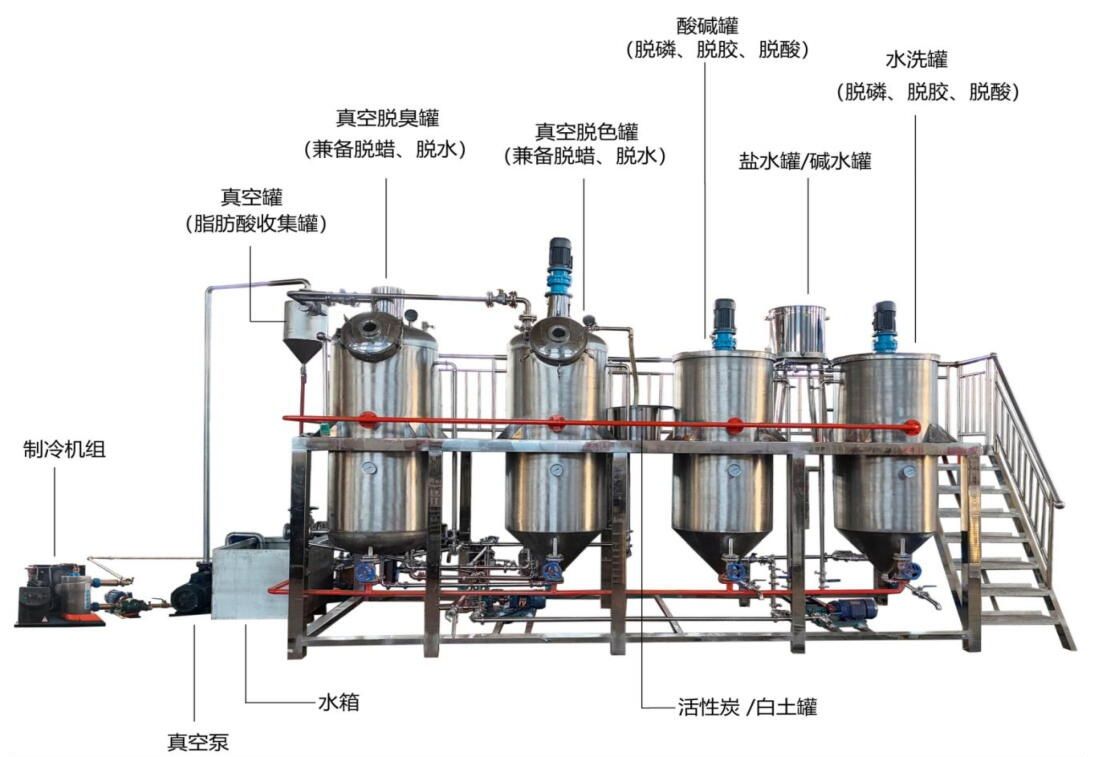
Edible Oil Refining System
Oil refining is the process of purifying crude oil. Impurities in crude oil not only affect the food quality and safe storage of the oil but also create difficulties for further processing. The goal of refining is not to remove all "impurities" from the oil, but to remove those that adversely affect usage, storage, and industrial production.
Beneficial "impurities" such as tocopherols (Vitamin E) and sterols should be retained as much as possible during the refining process.
- Degumming — Remove phospholipids and gums
- Neutralization (Deacidification) — Remove free fatty acids
- Washing — Remove soap residues
- Drying — Remove moisture
- Bleaching — Remove pigments for clear appearance
- Deodorization — Remove odors for neutral taste
- Capacity: 1-100 tons/day, fully customizable
- Includes: Neutralization tank, bleaching tank, deodorization tank, thermal oil furnace, vacuum pump
Process Flow
Crude Oil Input
Raw pressed oil enters the system.
Degumming
Phospholipids removed by hydration.
Neutralization
Free fatty acids neutralized with alkali.
Washing
Soapstock washed away.
Drying
Moisture removed under vacuum.
Bleaching
Pigments adsorbed onto bleaching clay.
Deodorization
Volatiles stripped by steam under vacuum.
RBD Finished Oil
Clear, odorless, bottled-ready oil.
Refining Methods Overview
Mechanical Methods
Settling, filtration, centrifugal separation — physical impurity removal.
Chemical Methods
Acid refining, alkali neutralization, oxidation-reduction, esterification — chemical impurity removal.
Physical-Chemical Methods
Hydration, adsorption, steam distillation, liquid-liquid extraction, freeze crystallization — combined approach.
Our Approach
Optimized process of methods tailored to each customer's specific oil type and quality requirements.
How Edible Oil Refining Equipment Works
The edible oil refining equipment from HaoNuo Machinery is a semi-continuous system that transforms crude pressed oil into clear, odorless, shelf-stable RBD (Refined, Bleached, Deodorized) oil suitable for bottling and direct consumption. The process flows through seven stages: (1) Crude oil input — raw oil from the hydraulic press enters the system, still containing phospholipids, free fatty acids, pigments, and moisture. (2) Degumming — hot water or phosphoric acid is mixed in to hydrate gums and phospholipids, which are then separated by centrifugal force or settling. (3) Neutralization (Deacidification) — food-grade alkali (typically sodium hydroxide) reacts with free fatty acids to form soapstock, which is separated, reducing the acid value to edible standards. (4) Washing — the neutralized oil is washed with hot water to remove residual soap traces. (5) Drying — vacuum dehydration removes moisture, preventing cloudiness and microbial growth. (6) Bleaching — activated bleaching earth adsorbs color pigments (chlorophyll, carotenoids), producing a clear, light-colored oil. (7) Deodorization — high-temperature steam stripping under vacuum removes volatile odor compounds, leaving a neutral-tasting finished oil.
A critical point about our crude oil refinery approach: the goal is NOT to strip the oil of everything. Beneficial components — Vitamin E (tocopherols), plant sterols, and natural antioxidants — are deliberately preserved because they contribute nutritional value and oxidative stability. HaoNuo's process parameters are tuned to remove only what degrades oil quality (FFAs, gums, pigments, odors) while keeping what the consumer benefits from. The system is available in capacities from 1 ton/day for small artisan mills up to 100 tons/day for industrial-scale refineries. The semi-continuous design offers the best balance: batch-style processing for degumming and neutralization where precise chemical dosing matters, combined with continuous flow for bleaching and deodorization where steady throughput maximizes efficiency. Individual equipment includes neutralization tanks, bleaching tanks, deodorization tanks, a thermal oil furnace for process heating, and a vacuum pump system.
Application Scenarios & Use Cases
Premium Edible Oil Brands (India, Middle East)
Indian and Middle Eastern brands producing bottled mustard, groundnut, and sunflower oil require edible oil refining to meet food safety standards and consumer expectations for clear, odorless oil. Our semi-continuous crude oil refinery produces consistently high-grade RBD oil batch after batch.
Export-Oriented Mills (Africa, Southeast Asia)
Export markets in Europe, North America, and Japan demand refined oil meeting strict quality specifications. Nigerian palm oil exporters and Vietnamese peanut oil producers use our refining equipment to upgrade crude pressed oil to export-grade refined product.
Integrated Mill-to-Bottle Operations
Mills that press, refine, and bottle on-site gain full quality control and capture the entire value chain margin. A 5-10 ton/day oil refining equipment line paired with HaoNuo hydraulic presses creates a complete seed-to-shelf production facility.
Multi-Seed Refining Flexibility
The same refining line can process different oils — mustard one week, groundnut the next, soybean after that — with simple cleaning and parameter adjustments between runs. This flexibility is essential for mills serving diverse regional markets.
Operation Tips & Best Practices
- Crude oil quality assessment: Test incoming crude oil for acid value, moisture, and impurity content before starting the refining process. High-FFA crude requires more alkali in neutralization; high-moisture crude benefits from pre-drying to reduce degumming chemical consumption.
- Degumming temperature control: Maintain 60-70°C during hydration degumming. Temperatures below 55°C produce incomplete gum hydration; above 80°C can darken the oil prematurely and reduce bleaching efficiency later in the edible oil refining process.
- Alkali dosing precision: Calculate sodium hydroxide quantity based on the acid value of each batch plus a small excess (0.05-0.1%). Under-dosing leaves residual FFAs; over-dosing saponifies neutral oil — a direct yield loss. Use a titration test before each batch for accuracy.
- Bleaching earth selection: Choose activated bleaching earth grade based on the oil type. Dark oils (palm, cottonseed) need higher-activity earth; light oils (groundnut, sunflower) work with standard grades. Typical dosage: 1-3% of oil weight.
- Deodorization parameters: Maintain 220-250°C under 3-5 mbar vacuum for 30-60 minutes depending on oil type. Higher temperatures or longer times strip beneficial tocopherols; insufficient time leaves residual odors detectable in the finished product.
- Equipment cleaning between oil types: When switching from one oil type to another (e.g., mustard to groundnut), flush all tanks and pipelines with hot water and a small amount of neutral oil to prevent cross-contamination of flavors and colors.
- Thermal oil furnace maintenance: Check thermal oil level and quality monthly. Degraded thermal oil loses heat transfer efficiency and can coke inside the heating jacket, creating hot spots. Replace thermal oil every 12-18 months of continuous operation.
Frequently Asked Questions
What capacities are available?
1 ton/day to 100 tons/day, fully customizable. Tell us your crude oil type and daily target, and we configure the system to match your exact requirements.
What oils can be refined?
Mustard, rapeseed, groundnut, sesame, soybean, sunflower, palm, coconut, cottonseed, corn germ, flaxseed, tea seed — all common edible oils.
Does refining destroy nutrients?
No. Our process preserves Vitamin E (tocopherols), plant sterols, and antioxidants. We remove only quality-degrading substances — gums, FFAs, pigments, odors — not beneficial components.
What is the price and lead time?
Contact HaoNuo via WhatsApp for a detailed quote based on your capacity and configuration. Lead time: 25-45 working days plus 15-35 days shipping to your port.
What equipment comes standard?
Neutralization tank, bleaching tank, deodorization tank, thermal oil furnace, vacuum pump, and interconnecting piping. Optional additions available on request.
Can I expand the system later?
Yes. Our semi-continuous design allows modular expansion. Start with 5 tons/day and add parallel tanks as volumes grow. We provide expansion planning support.
Refining Process Comparison: Batch vs. Semi-Continuous
HaoNuo Semi-Continuous Refining System
- Flow: Batch for degumming/neutralization, continuous for bleaching/deodorization
- Capacity: 1-100 tons/day — scalable modular design
- Oil loss: Lower (2-3%) — precise chemical dosing per batch
- Labor: 2-3 operators for full line
- Quality: Consistent RBD oil, batch traceability
- Best for: Mid-scale to large refineries needing quality and efficiency
Traditional Batch-Only Refining
- Flow: Everything in batch tanks, one stage at a time
- Capacity: <5 tons/day — slower turnaround
- Oil loss: Higher (3-5%) — less precise control
- Labor: 3-4 operators — more manual handling
- Quality: Variable between batches
- Best for: Very small artisan mills with minimal output