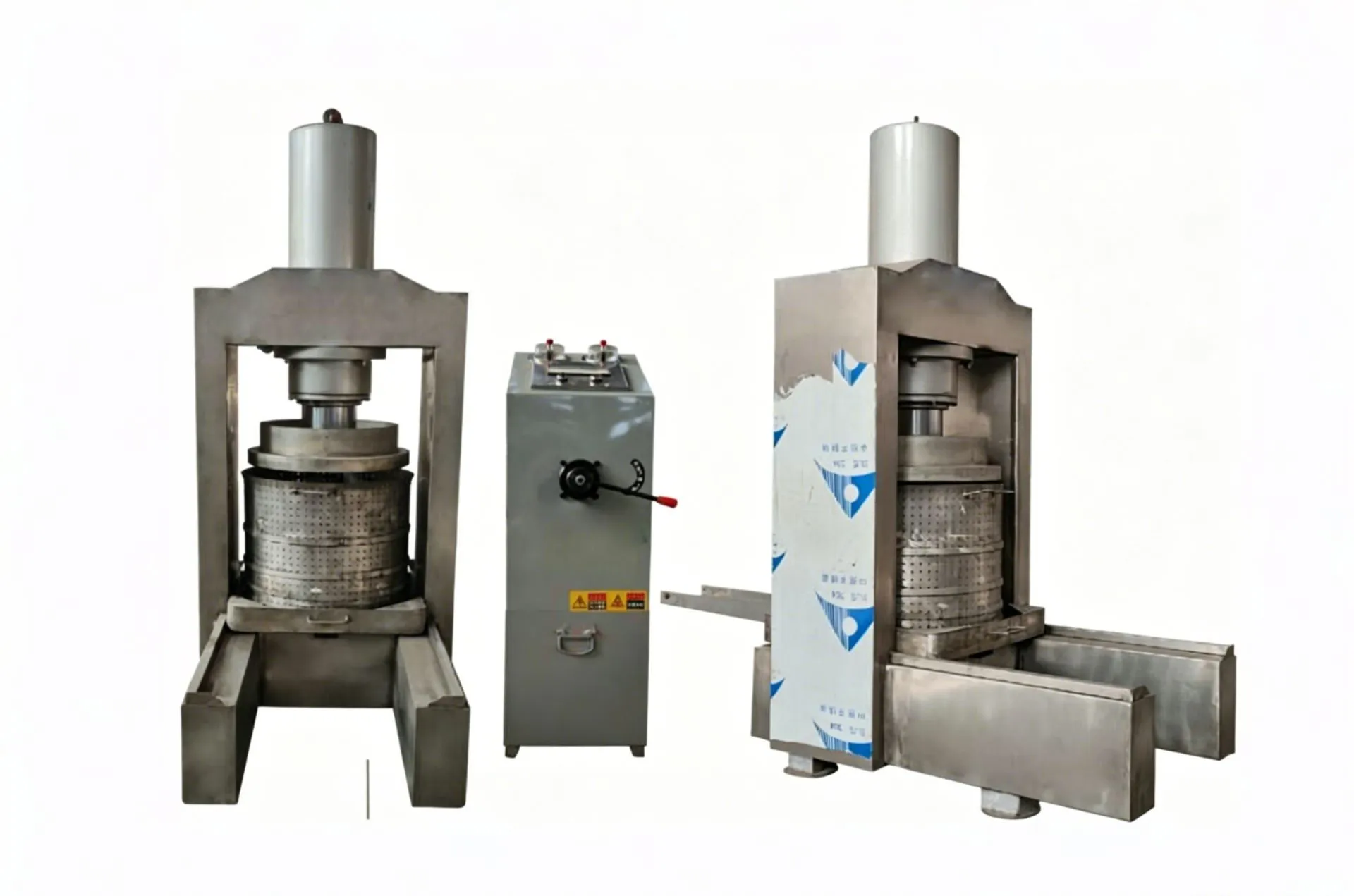
Coconut / VCO Special Press — 300 Type
This is a customized 300-type model. The barrel and oil tray are made of 304 food-grade stainless steel. The entire machine and pressing head are wrapped in 304 stainless steel to prevent coconut juice corrosion.
It can also press various fruit juices, dehydrate fruits and vegetables, and press oil sludge. This model is primarily used for pressing coconut juice, with many customers from Hainan (China), Southeast Asia, Philippines, Indonesia, Thailand, Sri Lanka, and Fiji.
- 304 food-grade stainless steel — barrel, oil tray, AND full body wrap
- 300 tons pressing force at 60 Mpa system pressure
- 600mm diameter barrel — large capacity for coconut processing
- Virgin Coconut Oil (VCO) and coconut milk — dual purpose on one machine
- Also suitable for fruit/vegetable juice extraction and dehydration
- Acid-resistant construction prevents corrosion from coconut juice
- Compact footprint: 2100×1260×2200mm
- Lightweight at ~1.3 tons — easy installation
300-Type Coconut Press Specifications
| Parameter | Specification |
|---|---|
| Pressing Force | 300 Tons |
| System Pressure | 60 Mpa |
| Cake Surface Pressure | 10.83 Mpa/cm² |
| Barrel Inner Diameter | 600 mm |
| Barrel Height | 600 mm |
| Cylinder Outer Diameter | 300 mm |
| Cylinder Inner Diameter | 240 mm |
| Cylinder Stroke | 700 mm |
| Motor Power | 2.2 KW |
| Machine Weight | ~1.3 Tons |
| Overall Dimensions | 2100×1260×2200 mm |
| Applications | Coconut juice/milk, VCO, fruit/vegetable juice, dehydration, oil sludge |
| Markets | Philippines, Indonesia, Thailand, Sri Lanka, Hainan (China), Southeast Asia |
What Can You Make?
Virgin Coconut Oil (VCO)
Cold-pressed virgin coconut oil for health food and cosmetics markets. Premium pricing vs refined coconut oil.
Coconut Milk
Food-grade extraction using the same machine. Switch between products by adjusting parameters.
Coconut Water / Juice
600mm large barrel processes whole coconuts efficiently. Multi-purpose dehydration capability.
VCO Production Process
Virgin Coconut Oil (VCO) production follows a cold-press extraction method that preserves the natural nutrients and aroma of fresh coconut. Start with mature coconuts harvested 10-12 months after flowering — younger nuts have less oil content, older nuts yield more but produce a stronger flavor. Grate the fresh coconut meat (copra is NOT used for VCO — copra processing produces RBD coconut oil, a different product). The grated meat goes directly into the 300-type press. The 304 stainless steel barrel protects against the natural acidity of coconut, and the 10.83 Mpa cake pressure extracts the oil-rich coconut milk without heat. Let the pressed coconut milk settle for 12-24 hours — the oil naturally separates from the water phase. Skim the VCO from the top, then filter through a fine mesh or filter press. The result: clear, aromatic VCO with FFA below 0.1%, ready for bottling. Yield is approximately 20-25% VCO by weight of fresh grated coconut meat. The remaining pressed coconut residue can be dried and sold as desiccated coconut or animal feed.
Coconut Business Models
Philippines & Indonesia: VCO Export Hub
The Philippines is the world's largest coconut producer, and VCO is a flagship export product with APCC (Asian and Pacific Coconut Community) certification standards. A single 300-type press processing 500 kg of fresh grated coconut daily yields roughly 100-125 liters of VCO — at export prices of USD 8-15 per liter, that's a significant daily return. Indonesian producers in Sulawesi and Sumatra follow similar export models, with growing demand from European organic cosmetics buyers and US health food importers. The key certification requirements: FFA below 0.1%, moisture below 0.1%, and microbiological testing for export-grade VCO.
Sri Lanka & Pacific Islands: Multi-Product Strategy
Sri Lankan producers combine VCO pressing with coconut milk and coconut flour production on the same 300-type machine. The copra moisture standard is 6-7% for efficient oil extraction, and FFA standards must meet APCC export specifications. In Fiji, Samoa, and other Pacific islands, small-scale producers use the 300-type press for domestic coconut oil production supplemented by fruit juice extraction during mango and pineapple seasons — the machine's multi-purpose capability provides year-round utilization. This approach spreads equipment costs across multiple revenue streams and keeps the press running even when coconuts are out of season.
Food Safety & Certification
The 300-type press is designed for food-grade production from the ground up. Every component that contacts coconut meets international standards:
- 304 Stainless Steel: Barrel, oil tray, and full body wrap — resists coconut juice corrosion and meets FDA food contact requirements
- FFA Compliance: Cold-pressed VCO consistently achieves FFA below 0.1%, meeting APCC virgin coconut oil standards
- Clean-in-Place Design: Stainless steel surfaces allow thorough cleaning between product switches — critical for organic certification
- Copra Moisture Standard: For traditional coconut oil pressing (not VCO), copra should be dried to 6-7% moisture for optimal extraction
- Export Documentation: Full material certificates, food-grade compliance documentation, and fumigation certificates provided with shipment
Frequently Asked Questions
What's the difference between VCO and regular coconut oil?
VCO (Virgin Coconut Oil) is cold-pressed from fresh coconut meat without heat or chemical refining. It retains the natural coconut aroma, lauric acid content (45-53%), and bioactive compounds. Regular RBD coconut oil is made from dried copra that undergoes refining, bleaching, and deodorizing — it loses most of its natural aroma and some nutritional compounds. VCO sells at a significant premium: USD 8-15 per liter versus USD 1-3 per liter for RBD coconut oil. The 300-type press produces both — use fresh grated coconut for VCO, or dried copra at 6-7% moisture for traditional coconut oil.
Why is 304 stainless steel important for coconut processing?
Coconut juice and meat are naturally acidic (pH 5.0-6.0) and can corrode carbon steel over time, leading to metal contamination in your oil. 304 food-grade stainless steel resists this corrosion completely. It's also non-reactive, so your coconut oil maintains its natural color and flavor without picking up metallic notes. For VCO producers pursuing organic or food safety certification (HACCP, ISO 22000), stainless steel contact surfaces are often a mandatory requirement.
Can I use the 300-type press for other products?
Yes — that's one of its main advantages. Beyond VCO and coconut milk, the 300-type press handles fruit juice extraction (mango, pineapple, passion fruit), vegetable juice, dehydration of fruits and vegetables, and even oil sludge pressing. Many operators in Southeast Asia run coconut processing for part of the year and switch to seasonal fruit juice production during harvest periods. The large 600mm barrel handles whole fruit chunks without pre-processing.
What coconut varieties work best for VCO?
Tall varieties (Typica) generally produce higher oil content than dwarf varieties, but both work well. In the Philippines, Laguna and San Ramon varieties are preferred for VCO production. In Indonesia, the Dalam variety is widely used. The key factor is maturity: harvest at 10-12 months when the coconut meat is thick (at least 8-10mm) and oil content peaks. Older nuts (12+ months) have higher oil content but the meat is tougher and harder to grate. Freshness matters — coconut meat should be processed within 24-48 hours of opening to prevent FFA from rising.
How do I get APCC export certification for my VCO?
APCC (Asian and Pacific Coconut Community) sets the international standard for VCO quality. Key specifications include: FFA below 0.1%, moisture content below 0.1%, peroxide value below 3 meq/kg, and lauric acid content of 43-53%. Your national coconut authority (PCA in Philippines, CRI in Sri Lanka, etc.) typically handles APCC certification testing. The 300-type press with 304 stainless steel construction helps you meet the food safety and quality requirements. We provide material certificates and food-grade compliance documentation with every machine to support your certification application.