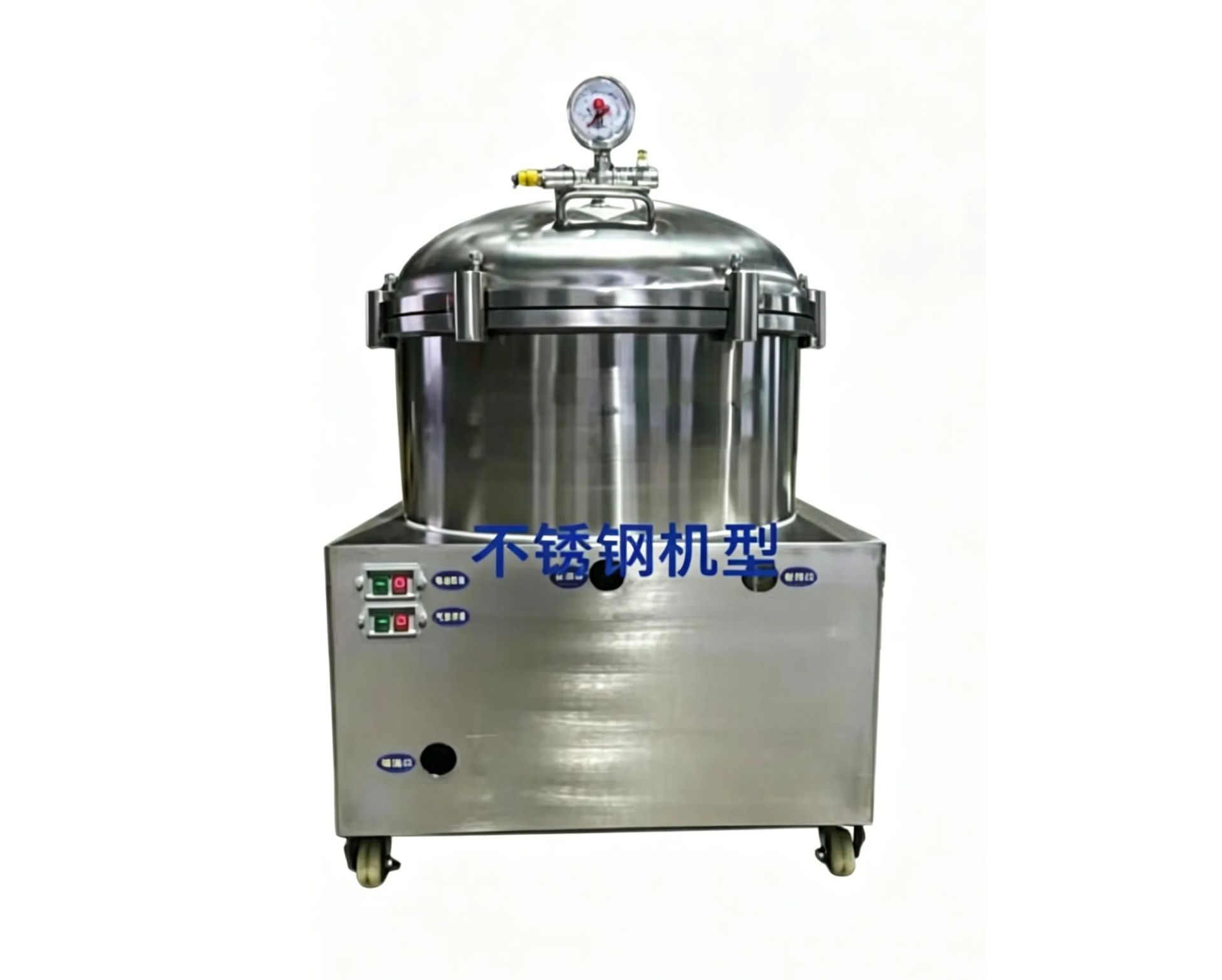
27KW New Electric Steamer (Upgraded)
This is a completely upgraded version of our factory's previous model. It features a thickened dual water tank design with separate heating and water injection functions — the main tank handles heating while the auxiliary tank is a negative-pressure tank providing water injection.
The main tank has larger capacity. Tanks, connecting pipes, and fittings are all 304 stainless steel. Maximum single-batch capacity: 100 kg. Materials can be fully steamed through in just 20 minutes.
- Dual tank design — main tank heats, auxiliary tank injects steam
- 304 stainless steel tanks, pipes, and fittings throughout
- 3-level adjustable power: 9/18/27 KW
- Fully steams 100 kg in just 20 minutes
- Separated electrical/water sections for maximum safety
- Emergency stop switch included
- Quick-open maintenance access panel
- Dual drainage outlets — easy scale cleaning
- Independent float system — lower failure rate, quick repair access
- Lightweight at ~54 kg — easy installation
Specifications
| Parameter | Value |
|---|---|
| Water Filling Method | Manual / Automatic (dual mode) |
| Barrel Depth | 600 mm |
| Barrel Inner Diameter | 600 mm |
| Max Processing Capacity | 100 kg |
| Total Power | 27 KW (3-level adjustable) |
| Machine Weight | ~54 kg |
| Material | 201 Stainless Steel |
| Dimensions | 1100×700×1550 mm |
| Steam-Through Time | ~20 minutes per batch |
How the 27KW Electric Seed Steamer Works
The electric seed steamer machine (also known as an oilseed cooker or steaming equipment) uses electrical heating elements immersed in a water-filled primary tank to generate continuous steam. Water in the main tank is heated to boiling by 27 KW of power, adjustable in three stages (9/18/27 KW) to match different production volumes and seed types. The steam rises evenly through the 304 stainless steel cooking pot, penetrating the oilseed mass from bottom to top via natural convection. An auxiliary negative-pressure water tank automatically feeds fresh water into the main tank as steam is consumed, ensuring uninterrupted operation without manual refilling mid-batch.
Why is steaming critical before hydraulic pressing? Raw oil seeds contain oil locked within rigid cell walls. Applying dry pressure alone yields only partial extraction. Seed steaming softens the cell walls, coagulates proteins, and reduces oil viscosity — three changes that dramatically improve oil release during pressing. For hard seeds like mustard, rapeseed, and soybean, a 20-minute steam-through cycle in this oilseed cooker raises moisture content to the optimal 8-10% range, increasing press yield by 15-25% compared to unsteamed seeds. The HN-ST-E achieves this in batches of up to 100 kg, with full steam penetration in approximately 20 minutes. The dual-tank design means the machine continuously produces steam without pause for refilling — a significant upgrade over single-tank competitors that must stop between batches. Safety features include separated electrical and water sections, an emergency stop switch, and independent float-level monitoring for each tank. At only 54 kg and 1100×700×1550 mm, it installs in most workshop layouts without modification.
Application Scenarios & Use Cases
Mustard & Rapeseed Oil Mills (India, Nepal, Bangladesh)
Mustard and rapeseed require thorough seed steaming to release their pungent oils. The 27 KW steamer processes 100 kg per batch in ~20 minutes — enough to feed two hydraulic presses simultaneously. Indian mill owners appreciate the 3-level power adjustment for matching production pace.
Sesame Oil Production (Ethiopia, Sudan, Myanmar)
Sesame seeds benefit from gentle steaming to improve oil yield without darkening the oil's prized golden color. The stainless steel pot and precise power control of this steaming equipment prevent scorching that cheaper steamers with hot spots can cause.
Groundnut Processing (West Africa, Indonesia)
Groundnuts (peanuts) soften significantly after steaming, improving press throughput and cake formation. Nigerian processors using the 27 KW oilseed cooker report 20% faster pressing cycles and cleaner oil with less sediment compared to cold pressing.
Multi-Seed Processing Lines (Southeast Asia)
For mills handling coconut, palm kernel, peanut, and soybean on the same line, the adjustable power levels let operators dial in the right steaming intensity for each material without over-processing delicate seeds.
Operation Tips & Best Practices
- Water quality matters: Use clean, low-mineral water in both tanks. Hard water causes scale buildup on heating elements, reducing efficiency and lifespan. If local water is hard, consider installing a simple water softener upstream.
- Startup sequence: Fill both tanks before powering on. Set to 27 KW for initial heat-up (approximately 15 minutes to boiling), then reduce to 18 KW for continuous production. Never run the seed steaming machine with an empty tank.
- Batch loading technique: Load seeds loosely — do not compact them. Steam needs free pathways to penetrate evenly. Over-packed batches result in under-steamed cores and over-steamed outer layers.
- Steam-through timing: For most oil seeds (mustard, rapeseed, soybean), 20 minutes achieves full steam penetration. Monitor the steam vent — when steam exits uniformly from all sides, the batch is ready.
- Power level selection guide: Use 9 KW for small batches (under 50 kg) or delicate seeds. Use 18 KW for standard production. Reserve 27 KW for maximum throughput or initial heat-up only — continuous 27 KW may over-steam the outer layers.
- Scale removal: Drain both tanks weekly via the dual drainage outlets. For heavy scale buildup, fill with diluted food-grade descaling solution, heat to 60°C for 30 minutes, then drain and rinse thoroughly.
- Float system check: The independent float mechanism controls water level in each tank. Verify float movement monthly — a stuck float can cause tank overflow or dry heating element failure.
Frequently Asked Questions
How many kg per batch and per hour?
100 kg per batch, ~20 minutes per cycle. Practical throughput: 3 batches or ~300 kg per hour in continuous operation with proper staging.
Which seeds work with this steamer?
Mustard, rapeseed, sesame, groundnut, soybean, sunflower, flax, coconut, palm kernel, tea seeds — all common oil seeds. The 304 SS pot is food-grade compatible.
What power supply do I need?
380V 3-phase, up to 27 KW draw. Three adjustable levels: 9/18/27 KW. Most mills run at 18 KW for standard production, 27 KW for peak periods.
What is the price and delivery?
Contact us via WhatsApp for current FOB/CIF pricing. Lead time: 7-15 working days. Sea freight: 15-35 days to major ports worldwide.
Electric vs. wood-fired — which should I choose?
Electric = precise control, cleaner, indoor use. Wood-fired = lower upfront cost, no electricity needed, outdoor/remote use. Both handle 100 kg/batch.
Does steaming really improve oil yield?
Yes — significantly. Proper steaming can boost oil yield by 15-25% for hard seeds like mustard and rapeseed compared to cold pressing alone.
Equipment Comparison: Electric vs. Wood-Fired Steamer
27KW Electric Seed Steamer (HN-ST-E)
- Power source: 380V 3-phase electricity
- Control: 3-level adjustable (9/18/27 KW)
- Operation: Clean, smokeless, indoor-suitable
- Water system: Dual-tank automatic refill
- Safety: Electric-water separation, emergency stop
- Weight: 54 kg — easy to position
- Best for: Grid-connected workshops, consistent production
Wood-Fired Steamer 60 Type (HN-ST-W)
- Power source: Coal, wood, or gas fuel
- Control: Manual fuel adjustment
- Operation: Requires ventilation/chimney
- Water system: Integrated tank, manual refill
- Safety: Standard fire-safety practices
- Weight: 78 kg — still portable
- Best for: Off-grid locations, low-budget startups